Sound isolation and room acoustics are different.
Sound isolation is designed to keep sound from escaping or entering. Room acoustics is designed to control how sound reflects, decays, interferes and is heard indoors. Even when they look similar, their purposes are fundamentally different.
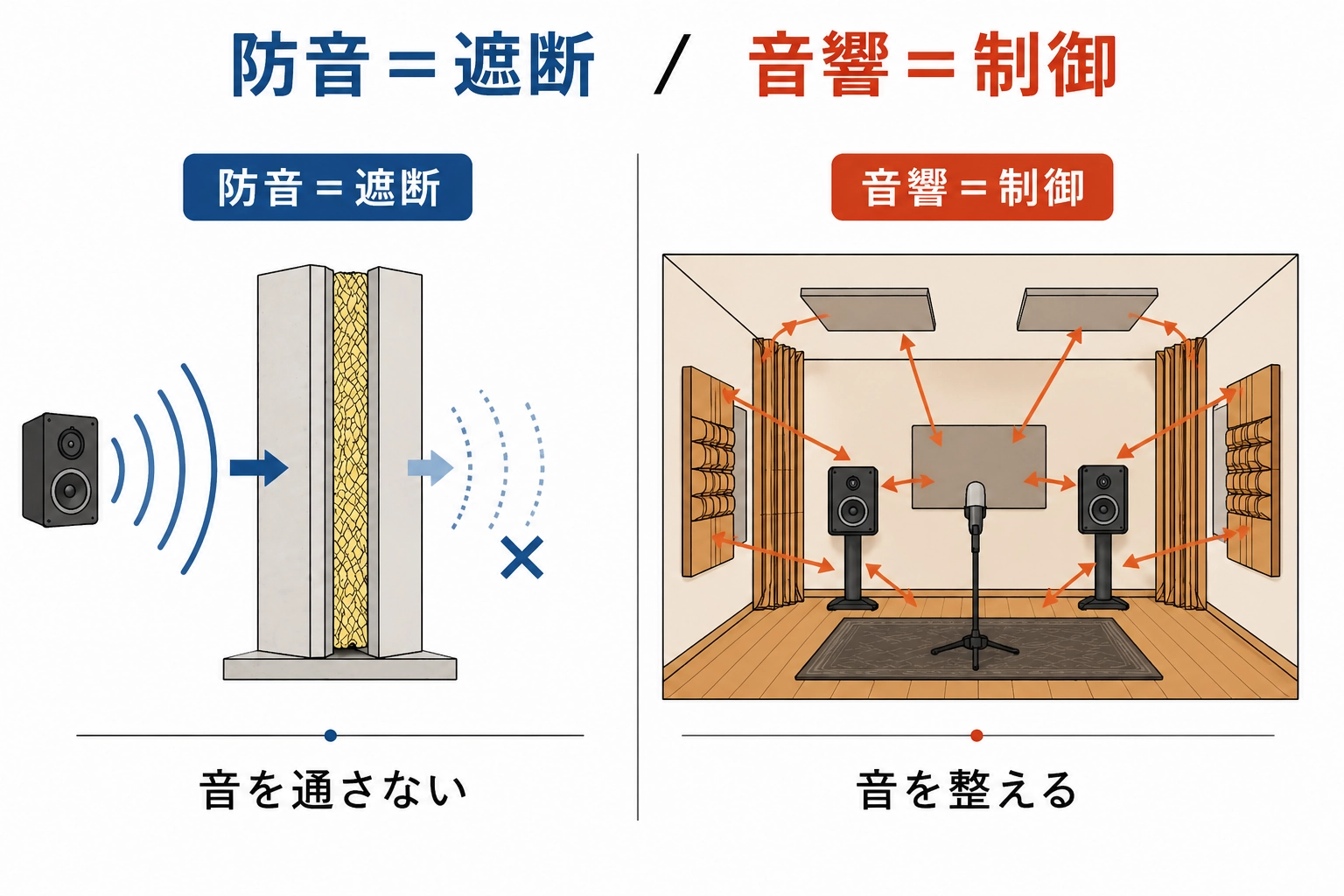
Read the overview diagram as text
This is the text version of the diagram above.
Sound isolation = blocking. Do not let sound through.
Room acoustics = control. Shape the sound.
Why they are confused
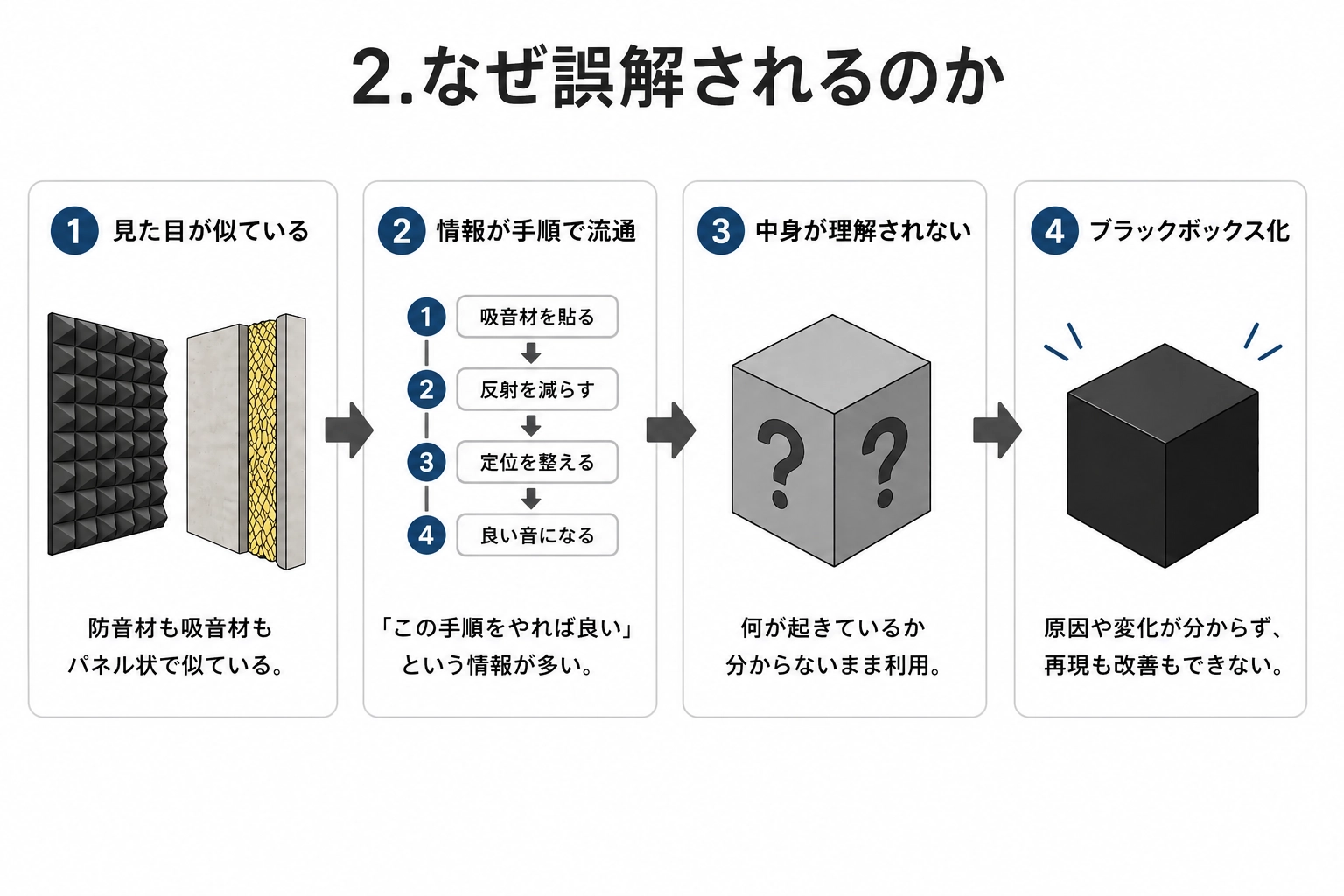
Read the confusion diagram as text
This is the text version of the diagram above.
2. Why the misunderstanding happens
1. Similar appearance: soundproofing and absorbing materials both look like panels.
2. Information circulates as steps: much advice says to simply follow a procedure.
Attach absorbing material → Reduce reflections → Adjust localization → Get good sound
3. The workings are not understood: used without understanding what is happening.
4. It becomes a black box: without understanding causes or changes, neither reproduction nor improvement is possible.
Soundproofing and sound-absorbing materials look similar, easily giving the impression that attaching them improves the sound. Much of the information also circulates as procedures, so the treatment alone is replicated without understanding what is happening, making it easy for it to become a black box.
Sound isolation
The purpose is to block sound: reduce leakage to the outside and intrusion from outside. Structure, mass, airtightness and vibration transmission are key considerations.
Room acoustics
The purpose is control: manage indoor reflections, reverberation, standing waves, frequency response and time response.
Problems with small soundproof booths
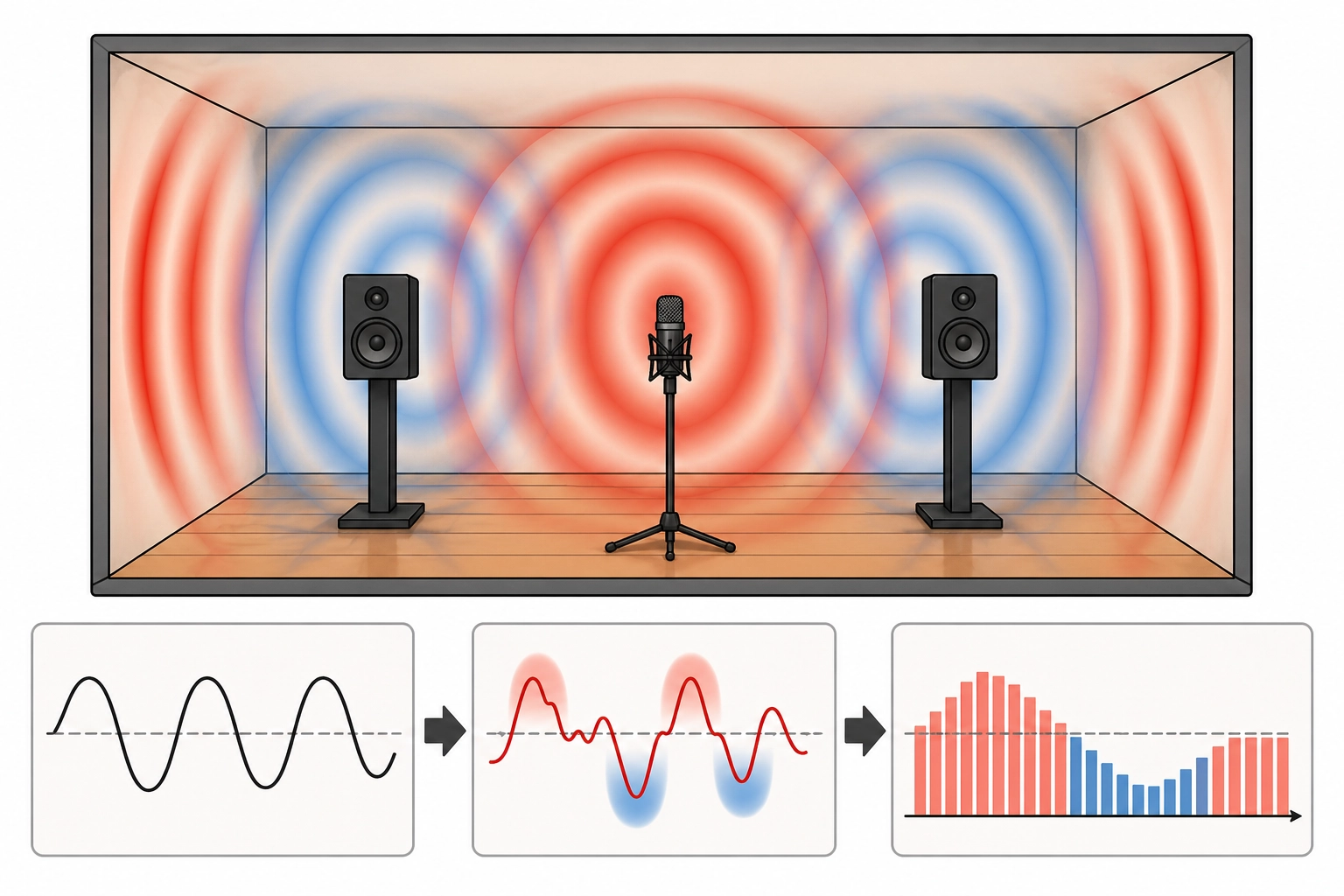
The small volume of a booth makes the distribution of low-frequency modes sparse, so peaks and dips in particular bands tend to stand out. Its interior walls also tend to be close together and parallel, allowing reflections to travel back and forth at short intervals and making flutter echo and uneven time response more likely.
Uneven low-frequency response
Low frequencies have long wavelengths and are difficult to handle in small spaces. Thin absorbing material alone may not provide enough control.
Reflections between parallel surfaces
When walls, ceiling and floor are close together and parallel, short back-and-forth reflections stand out and flutter echo becomes more likely.
Dead does not mean good
If only high frequencies are absorbed while low frequencies remain, a space can sound dead yet have a poor frequency balance.
Effects on recording
When the room's character reaches the microphone, it remains as an imbalance that is hard to correct in later processing.
Common misconceptions
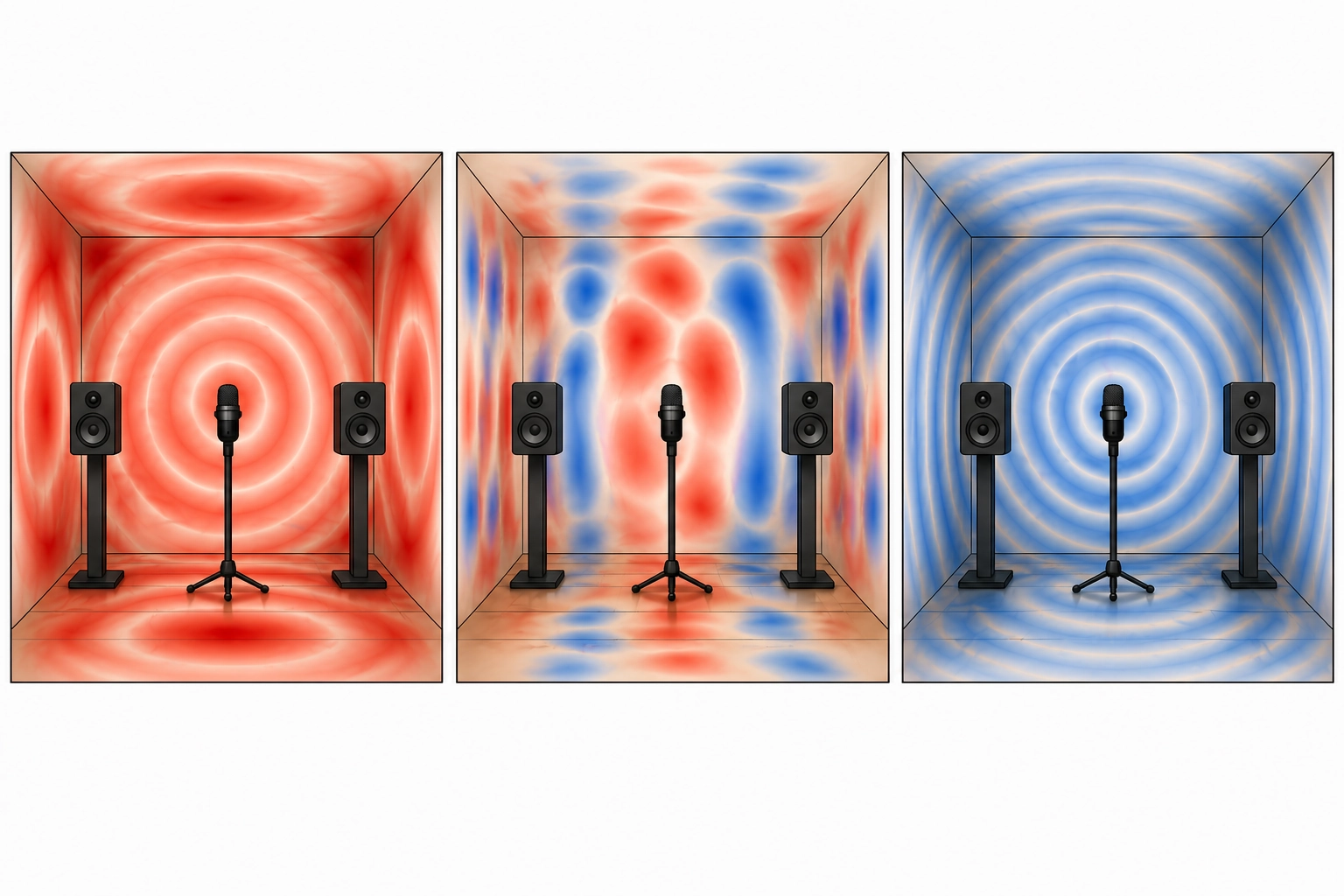
- Sound is good if absorbing material is attached
- Fewer reflections always make a space better for recording
- High sound isolation performance also means high acoustic performance
- A commercially available booth automatically has optimized internal acoustics
In reality, sound isolation and internal acoustics are separate dimensions. Even with high sound isolation performance, the internal frequency response and reverberation characteristics may not suit recording.
The essence is designing the whole space
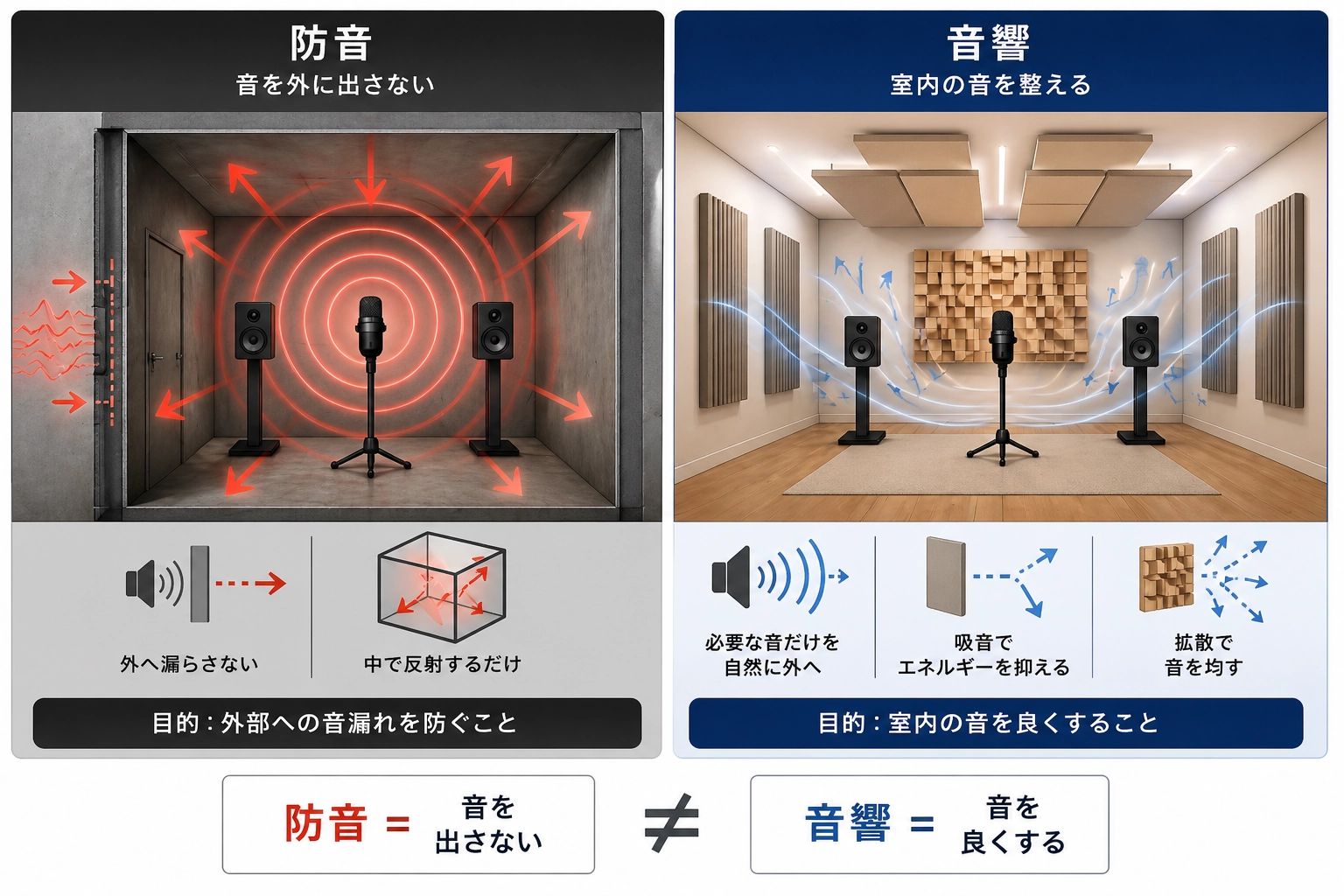
Read the isolation/acoustics comparison as text
This is the text version of the diagram above.
Sound isolation: keep sound from escaping
Do not let sound leak out. It only reflects inside. Purpose: prevent sound leakage to the outside.
Room acoustics: shape the sound indoors
Let only the necessary sound out naturally. Reduce energy through absorption. Even out sound through diffusion. Purpose: improve the sound inside the room.
Sound isolation = keeping sound in ≠ Room acoustics = improving sound
Acoustics is about phenomena occurring throughout a space, not individual pieces of equipment or materials. Results will not be stable without understanding which bands are amplified or attenuated where, which reflections return with what time delays, and where interference occurs.
Connection to mixing and ProtoOzone
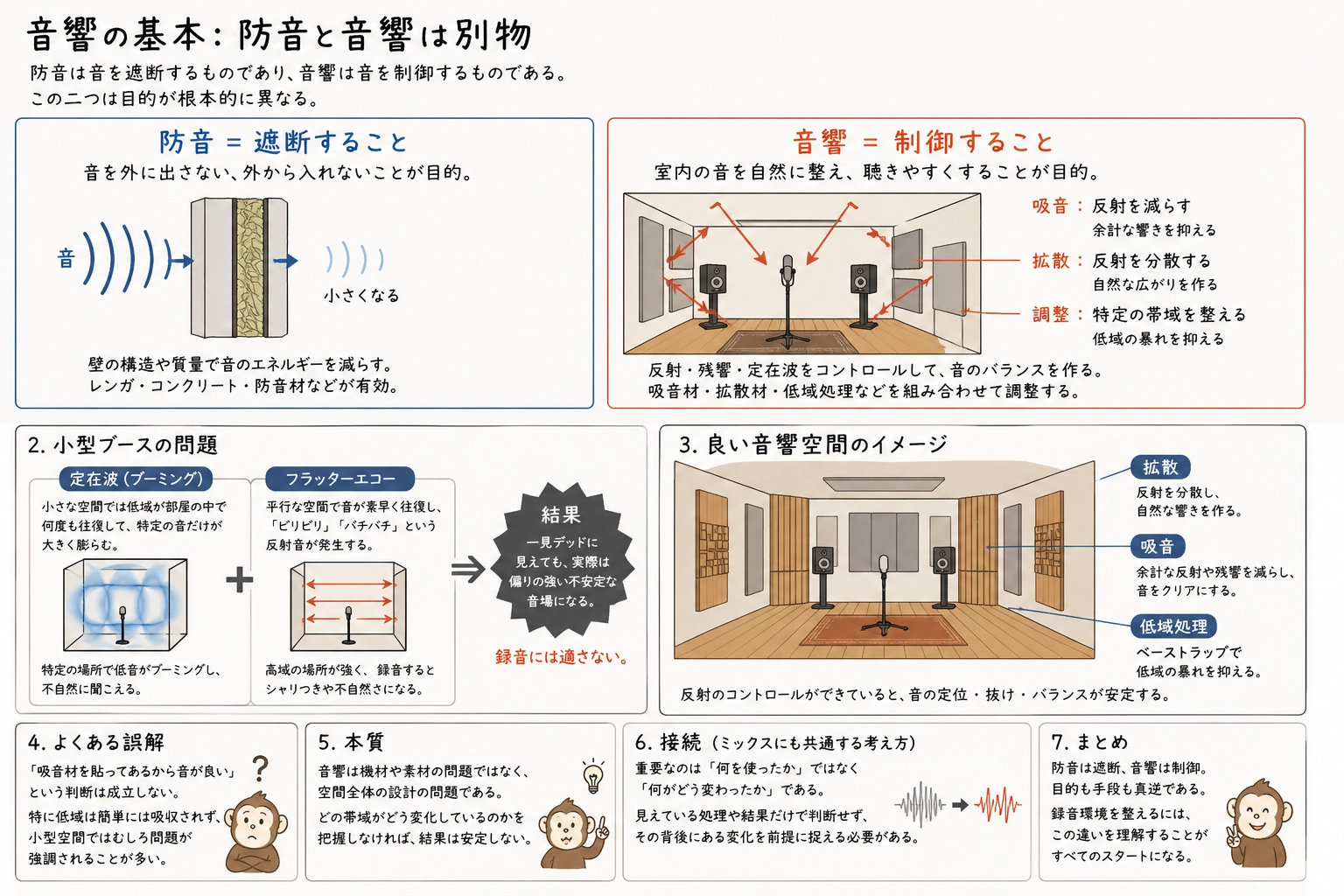
Read the summary diagram as text
This is the text version of the diagram above.
Acoustics basics: sound isolation and room acoustics are different
Sound isolation blocks sound; room acoustics controls sound. Their purposes are fundamentally different.
Sound isolation = blocking
The aim is to keep sound from escaping or entering. The wall's structure and mass reduce sound energy. Bricks, concrete and soundproofing materials are effective.
Sound → Becomes quieter
Room acoustics = control
The aim is to shape indoor sound naturally and make it easier to listen to. Control reflections, reverberation and standing waves to balance the sound. Adjust using a combination of absorption, diffusion and low-frequency treatment.
Absorption: reduce reflections and suppress excess reverberation.
Diffusion: disperse reflections and create a natural sense of spaciousness.
Adjustment: shape specific frequency bands and control excessive low-frequency response.
2. Problems with small booths
Standing waves (booming): in a small space, low frequencies travel back and forth repeatedly, making particular sounds swell. Bass booms in certain locations and sounds unnatural.
Flutter echo: sound travels rapidly back and forth between parallel surfaces, producing buzzing or crackling reflections. Areas with strong high-frequency response can sound harsh or unnatural in recordings.
Result: even if it seems dead, the sound field is actually strongly uneven and unstable. It is not suitable for recording.
3. A picture of a good acoustic space
Diffusion: disperse reflections and create natural reverberation.
Absorption: reduce excess reflections and reverberation to make the sound clear.
Low-frequency treatment: use bass traps to control excessive low-frequency response.
With reflections under control, localization, clarity and balance become stable.
4. Common misconceptions
Having absorbing material attached does not mean the sound is good. Low frequencies in particular are not easily absorbed, and problems are often emphasized in small spaces.
5. The essence
Acoustics concerns the design of the whole space, not individual equipment or materials. Results will not be stable without understanding which frequency bands change and how.
6. Connection (an idea shared with mixing)
What matters is what changed and how, rather than what was used. Do not judge only by visible processing or results; take the changes behind them into account.
7. Summary
Sound isolation blocks; room acoustics controls. Their purposes and means are opposites. Understanding this difference is the starting point for preparing a recording environment.
In both mixing and room acoustics, what matters is the change, not the means. If decisions are based only on visible things such as plugin names, absorbers or soundproof booths, reproducibility is lost as soon as conditions change.
ProtoOzone breaks things down by what changed and how, taking unseen layers into account. Reflections, interference, time delays and low-frequency modes in acoustics are similar: their directly invisible structures are inferred from the results to design the smallest necessary intervention.