Black-box dependence and numerical control
The essence of mixing is not to “just insert this plugin,” but to understand level, frequency bands and changes over time, and control them toward the state you need. Plugins are simply a means of achieving that control.
How it started
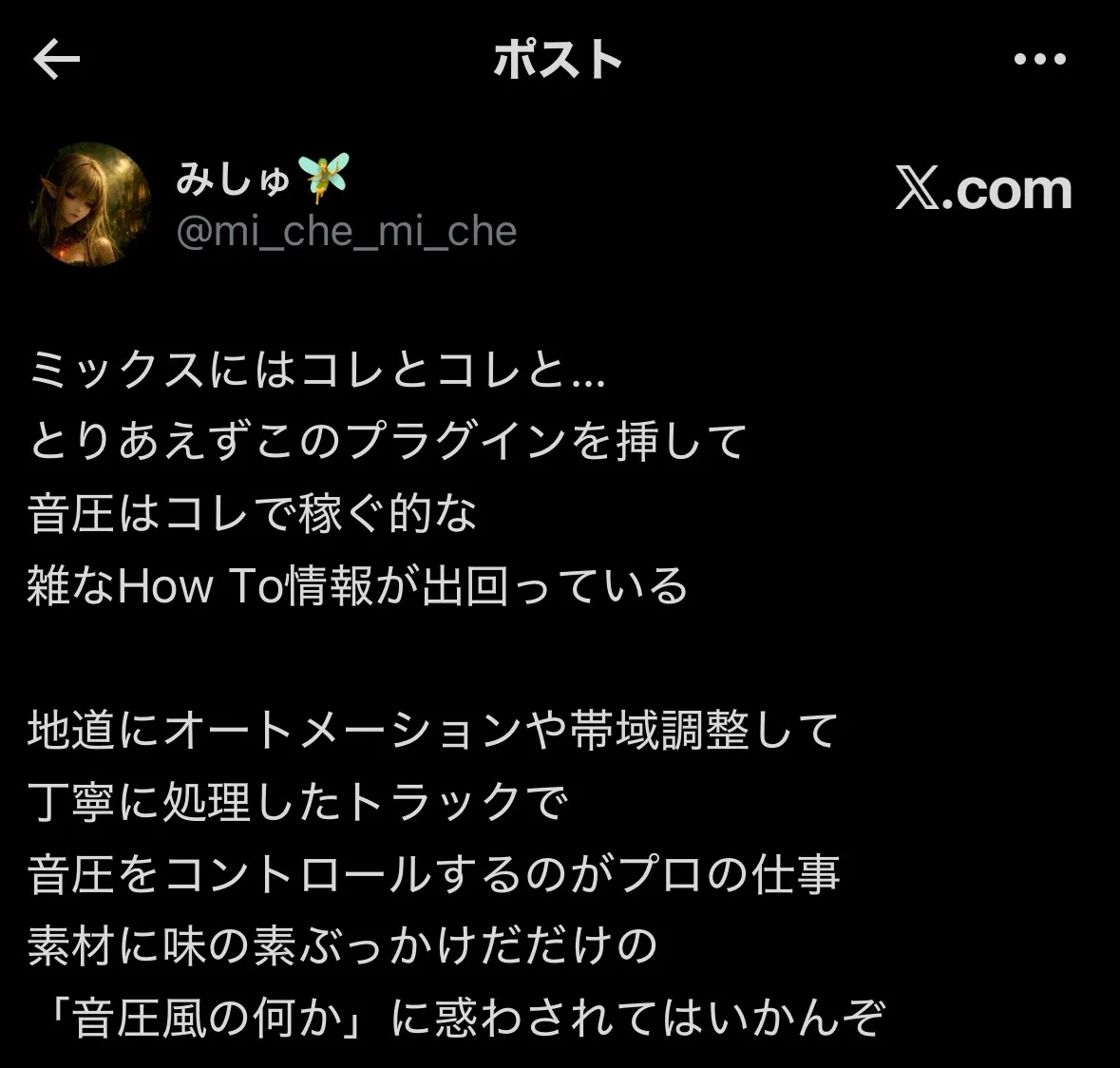
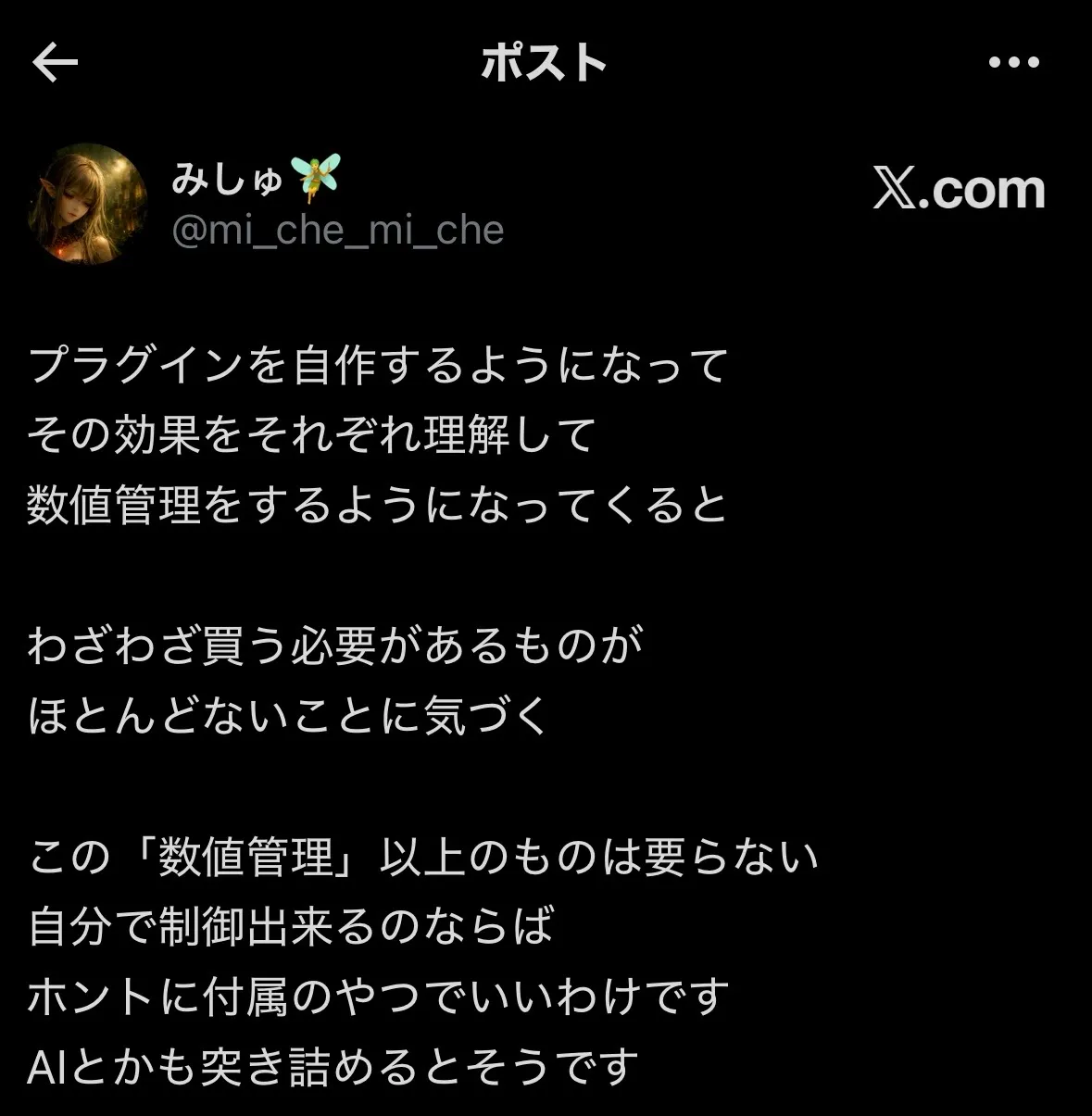
Once you build your own plugins, break down the effects of each process and manage them numerically, you come to realize that surprisingly few things actually need to be purchased. Meanwhile, general mixing advice often circulates as steps such as “insert this to get loudness,” without explaining what the processing does.
Problem structure
A particular plugin becomes the answer
The means becomes an end in itself, and what the processing actually changes is lost.
The illusion of loudness
Immediate changes that sound stronger or louder are overvalued relative to the control that is actually needed.
Processing becomes a black box
Without understanding what happens inside, you cannot make adjustments when the result breaks down.
Dependence on means rather than results
Decisions become about what to insert rather than the state you want to achieve.
The essence: controlling sound numerically
Mixing can be treated as a control task: observe the state of the sound and apply only the changes needed. At its core are at least the following three axes.
Level / dB
Address input, output, dynamics and gain structure.
Frequency bands / Hz
Identify which frequency bands have too much or too little, and what to keep or reduce.
Changes over time / ms
Address attack, release, transients and envelopes.
Amount of change
Compare what changed and by how much before and after processing to avoid overprocessing.
Why black-box dependence happens
- Results are immediate
- Understanding the internal structure takes substantial effort
- Successful examples and presets are more likely to be visible
- The causes of failure are not broken down, making it easy to move on to trying another plugin
- Advice tends to focus on steps, leaving out the underlying process
The result is a structure that prioritizes replication over understanding and creates dependence on steps rather than the meaning of the processing.
Countermeasures
- Break processing down to understand it
- Put into words what changed before and after processing
- Understand it through numbers such as dB, Hz and ms
- Return to the unprocessed state and verify whether the processing is really needed
- Judge by the purpose and amount of change, not the tool's name
Connection to ProtoOzone
ProtoOzone redesigns structures using what changed, rather than the result, as the smallest unit. The same applies to mixing: observing which components of the sound changed and how, rather than plugin names or processing steps, improves reproducibility and adjustability.