ProtoOzone
A protocol for redesigning the structure that produces results, rather than directly manipulating a particular target. It treats what changed and how as the smallest unit, rather than only observable results, and updates the state through minimal intervention while hypothesizing unobserved structures.
Overview
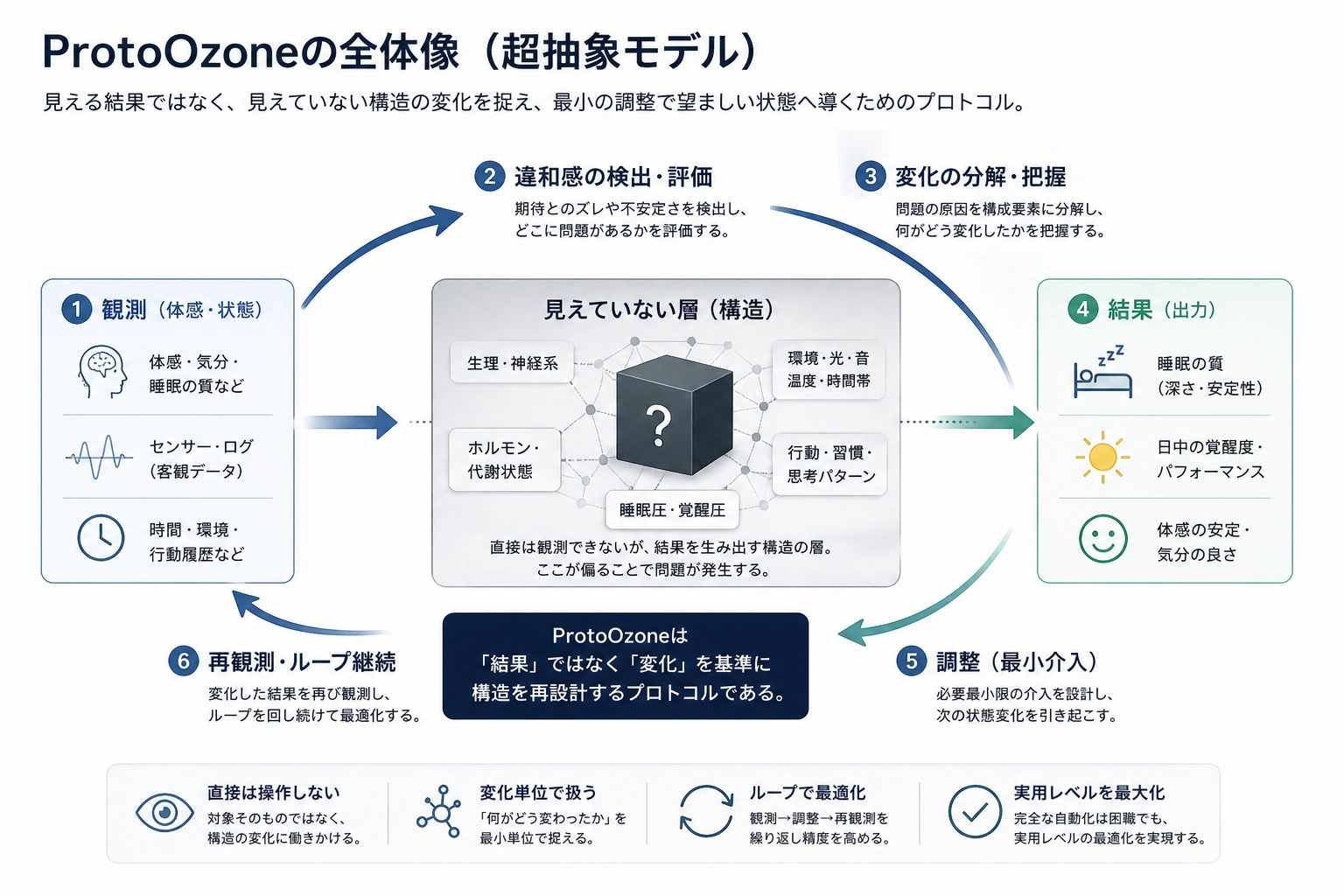
Read the text version of the diagram
The following is a text version of the Japanese diagram above.
ProtoOzone overview (highly abstract model)
A protocol for capturing changes in unseen structures rather than visible results, and moving toward a desired state with minimal adjustment.
1. Observation (subjective sensations and state)
Subjective sensations, mood, sleep quality, etc. / Sensors and logs (objective data) / Time, environment, behavioral history, etc.
2. Detect and evaluate discrepancies
Detect deviations from expectations or instability, and evaluate where the problem lies.
3. Break down and understand changes
Break down the cause of a problem into its components, and identify what changed and how.
Unseen layer (structure)
Physiology and nervous system
Hormones and metabolic state
Environment, light, sound, temperature and time of day
Behavior, habits and thought patterns
Sleep pressure and wakefulness pressure
A structural layer that cannot be directly observed but produces results. Imbalances here give rise to problems.
4. Results (output)
Sleep quality (depth and stability) / Daytime wakefulness and performance / Stable subjective sensations and positive mood
5. Adjustment (minimal intervention)
Design the minimum necessary intervention to bring about the next change in state.
6. Re-observe and continue the loop
Observe the changed results again and continue the loop to optimize.
ProtoOzone is a protocol for redesigning structures based on changes rather than results.
Do not manipulate directly
Act on changes in the structure rather than on the target itself.
Work in units of change
Capture what changed and how at the smallest unit.
Optimize through a loop
Improve precision by repeating observation → adjustment → re-observation.
Maximize practical usefulness
Achieve practical optimization even when complete automation is difficult.
Core idea
Many problems arise from imbalances in the structures or states behind an observable target, rather than from the target itself. ProtoOzone does not manipulate the target directly. It breaks down the changes leading to a result and treats the entire structure, including its black boxes, as the subject of adjustment.
Do not manipulate directly
Observe changes in the structure that produced a result, rather than intervening only in the visible result.
Work in units of change
Break things down into the smallest units of what changed and how.
Minimal intervention
Make only the minimum necessary changes, then observe the next change in state.
Optimize through a loop
Repeat observation → evaluation → decomposition → adjustment → re-observation.
Control loop
Observe
Detect a discrepancy
Break down changes
Result
Minimal intervention
Re-observe
Even without a complete understanding of the internal structure, the aim is practical optimization through repeated observation of how changes correspond to results.
Concrete application example: medication and sleep
The original protocol uses an example in which wakefulness is the primary control target and sleep is observed as its result. It is presented here as an example of a slow closed-loop control system with a human as the sensor.
Core idea
- Treat sleep as a result, rather than as the control target
- Make wakefulness (getting up and daytime performance) the primary control target
- Treat subjective sensations (sleepiness and hyperarousal) as the sensor
- Adjust one variable at a time
System configuration in the original record
Base layer (fixed)
Atomoxetine 120mg
Sodium valproate 400mg (considering 200mg depending on circumstances)
Recorded as serving to limit neural fluctuations and provide baseline daytime stability.
Wakefulness control layer
Concerta (extended-release methylphenidate)
4:00 → 36mg (start-up)
10:00 → 18mg (maintenance)
Recorded as aiming to stabilize getting up, maintain daytime performance, reduce the late-afternoon dip, and maintain natural sleep pressure at night.
Sleep support
Dayvigo: used only as needed (minimum dose)
The original record treats it as a fallback for being unable to fall asleep.
Observation metrics
Ease of getting up
Late-afternoon sleepiness and reduced concentration
Natural sleepiness at night
Adjustment rules in the original record
- Hyperarousal → delay the later dose or reduce the dose
- Insufficient wakefulness → move the first dose earlier
- Difficulty falling asleep → move the overall schedule earlier or reduce the dose
- No problem → make no change
Safety constraints in the original record
- Keep dose changes within the existing prescription range
- Adjust one variable at a time
- Stop immediately if severe anxiety, palpitations or panic occur
- Evaluate over at least several days and avoid judgments based on a single day
Example observation log
| First dose | Later dose | Getting up | Late afternoon | Night | |
|---|---|---|---|---|---|
| Day 1 | 4:00 36mg | 10:00 18mg | 6:10 | Mild sleepiness | 23:30 fell asleep naturally |
| Day 2 | 4:00 36mg | 10:30 18mg | 6:30 | Stable | Slight delay in falling asleep |
Assessment in the original record: the 10:00 dose provided a better balance.
Model interpretation
- Closed-loop control with a human as the sensor
- Wakefulness = output; subjective sensations = feedback
- A slow control system adjusted on a daily basis
- Update the structure based on changes rather than observable results
Conclusion
ProtoOzone is a protocol for observing changes and redesigning the structure that produces results, rather than directly controlling the results themselves. It does not assume complete automation or complete internal observation. It aims for practical optimization by repeating sensing, feedback, minimal intervention and re-observation.