Hypnagogic Processing Mode
This ShushuLab protocol organizes the state known as hypnagogia, the transition into sleep, as an operational model for creative work and thinking. Reduce external input, observe internal generation, and bring only useful fragments back to the waking state.
How to read this article
HPM does not claim to have newly discovered hypnagogia itself, a state at the onset of sleep known in sleep research. It organizes this known phenomenon in terms of conditions, input/output structure, uses, constraints and exit conditions, defining an operational model for creative work and thinking.
A picture of the state
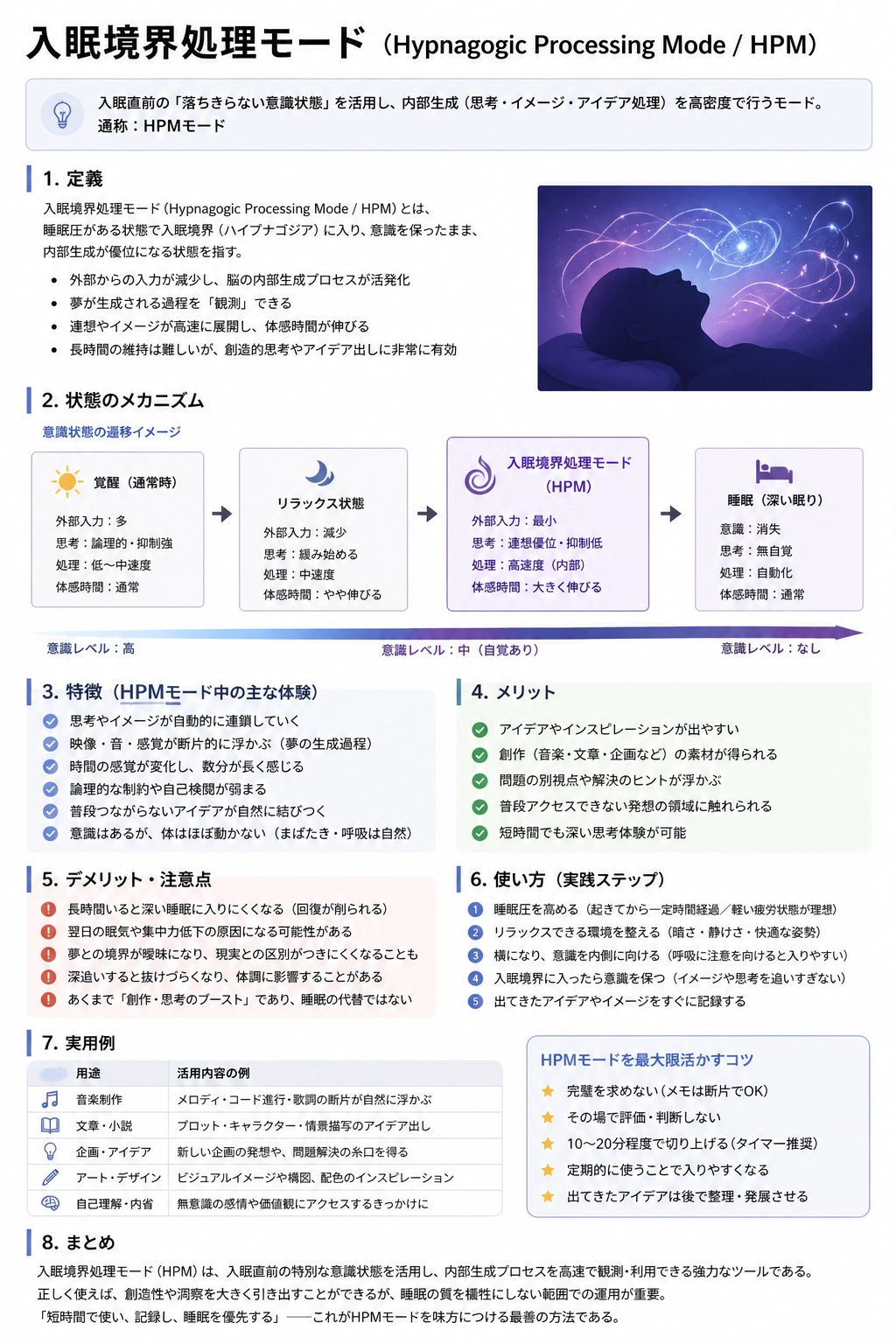
Read the text version of the diagram
The following is a text version of the Japanese diagram above. Read its descriptions of processing speed and similar terms as subjective model expressions, as explained in “How to read this article.”
A mode that uses the state of awareness just before sleep, before it fully fades, for high-density internal generation of thoughts, imagery and ideas. Common name: HPM mode.
1. Definition
Hypnagogic Processing Mode (HPM) refers to entering hypnagogia under sleep pressure, with internal generation becoming dominant while awareness is retained.
- External input decreases and the brain's internal generation process becomes more active
- The process of dream generation can be “observed”
- Associations and images unfold rapidly, and subjective time expands
- Difficult to sustain for long periods, but very effective for creative thinking and generating ideas
2. Mechanism of the state
A picture of the transition between states of awareness
Wakefulness (normal)
External input: high. Thought: logical, strongly inhibited. Processing: low to medium speed. Subjective time: normal.
Relaxed state
External input: decreasing. Thought: begins to loosen. Processing: medium speed. Subjective time: slightly expanded.
Hypnagogic Processing Mode (HPM)
External input: minimal. Thought: associations dominate, low inhibition. Processing: high speed (internal). Subjective time: greatly expanded.
Sleep (deep sleep)
Awareness: absent. Thought: without awareness. Processing: automated. Subjective time: normal.
Level of awareness: high → medium (self-aware) → none
3. Characteristics (main experiences in HPM mode)
- Thoughts and images connect automatically
- Images, sounds and sensations arise as fragments (the dream-generation process)
- The sense of time changes, and a few minutes feel long
- Logical constraints and self-censorship weaken
- Ideas that do not usually connect come together naturally
- Awareness remains, but the body is almost still (blinking and breathing are natural)
4. Benefits
- Ideas and inspiration arise more easily
- Material for creative work such as music, writing and planning can be obtained
- Alternative perspectives on problems and clues to solutions emerge
- It becomes possible to touch on areas of thought not usually accessible
- Even a short period can allow a deep thinking experience
5. Drawbacks and cautions
- Staying in the state for a long time makes it harder to enter deep sleep (reducing recovery)
- It may cause drowsiness or reduced concentration the next day
- The boundary with dreams may become blurred, making it difficult to distinguish them from reality
- Pushing too far can make it difficult to exit and may affect physical condition
- It is only a boost for creative work and thinking, not a substitute for sleep
6. How to use it (practical steps)
- Increase sleep pressure (ideally after being awake for a period of time or in a state of mild fatigue)
- Set up a relaxing environment (darkness, quiet and a comfortable posture)
- Lie down and turn attention inward (focusing on breathing makes it easier to enter)
- Retain awareness on entering hypnagogia (do not pursue images or thoughts too far)
- Record the ideas and images that arise immediately
7. Practical examples
- Music production: melodies, chord progressions and fragments of lyrics arise naturally
- Writing and fiction: generating ideas for plots, characters and descriptions of scenes
- Planning and ideas: finding ideas for new plans or leads toward solving problems
- Art and design: inspiration for visual imagery, composition and color schemes
- Self-understanding and reflection: an opportunity to access unconscious feelings and values
Tips for making the most of HPM mode
- Do not seek perfection (fragments are enough for notes)
- Do not evaluate or judge on the spot
- Stop after around 10–20 minutes (a timer is recommended)
- Regular use makes the state easier to enter
- Organize and develop the ideas that arise afterward
8. Summary
Hypnagogic Processing Mode (HPM) is a powerful tool that uses the special state of awareness just before sleep to observe and use internal generation processes at high speed. Used correctly, it can greatly draw out creativity and insight, but it is important to use it within limits that do not sacrifice sleep quality.
“Use it briefly, record, and prioritize sleep”—this is the best way to put HPM mode to work for you.
Scope and prerequisites
Prerequisite state
- Mild to moderate sleep pressure is present
- Not in a state of excessive arousal or tension
- External stimuli can be reduced to some extent
- Physical activity can be reduced
- The environment allows a transition into normal sleep
Conditions in which similar behavior is not guaranteed
- Severe insomnia
- Excessive arousal or tension
- Strong external stimulation that continues
- A state that differs from a natural transition into sleep
The nature of the state and its processing structure
This uses a mixed state in which some awareness remains while the body moves toward sleep. Attention to the outside world decreases, making internal imagery, associations and spontaneous fragments of thought more likely to come to the foreground.
Normal waking state
External input → Recognition and judgment → Thought → Output
HPM
External input (low) → Internal generation → Observation → Capture
It is better suited to generating material such as melodies, words, images, structures and associations than to producing a finished answer on the spot.
Changes in the sense of time
In HPM, synchronization with external events weakens, and changes in internally generated thoughts, images and sensations are more likely to become the experiential reference for time. As a result, it may feel as if many internal events occurred in a short period, or as if a few minutes lasted a long time.
Main characteristics observed during HPM
- Thoughts and images connect automatically
- Images, sounds, words and sensations emerge as fragments
- Self-censorship tends to weaken
- Elements that would not normally connect come together
- Logical constraints weaken
- The sense of time changes
- Going deeper leads directly into sleep
Practical examples
Creative work
Composition, melody generation, lyric fragments, prose, fiction, plots, character design and concept design.
Thinking
Restructuring problems, generating alternative perspectives on problems that have stalled, organizing abstract concepts and generating candidate ideas.
Sensory and spatial work
Visual imagery, design concepts, spatial structures and sonic imagery.
Primary use
Collect material to evaluate and edit while awake, rather than create a finished work.
Practical steps
- Begin in a state with mild drowsiness
- Lie down or reduce physical activity
- Reduce external stimuli such as light, sound and phone use
- Do not force a specific answer
- Observe images, words, sounds and structures that arise
- Capture only fragments that seem useful
- Exit before falling fully asleep, or after a set period
- Evaluate and organize your notes after waking
Operational model
Block input
Internal generation
Capture
Exit
Operational rules
- Use around 10–20 minutes per session as a guide
- Do not maintain the state for a long time
- Prepare a low-effort way to record, such as voice memos
- Do not try to produce a finished work
- Make judgments and evaluations after waking
- Do not keep pushing if nothing useful emerges
- Transition into normal sleep if you need sleep
Drawbacks and boundaries against misuse
Constraints
- Maintaining the state for a long time is difficult
- If awareness is lost, you simply fall asleep
- Holding on to awareness too strongly interferes with falling asleep
- Prolonged use may reduce sleep time and sleep quality
- The quality of the material is difficult to evaluate on the spot
- The content is easily forgotten unless recorded
Uses that are not intended
- Maintaining awareness for long periods
- Interrupting sleep every night
- Deliberately creating a state of sleep deprivation
- Using HPM alone to decide that a work is finished
Conclusion
Treat HPM as a temporary processing space for collecting material, not a place to create a finished work. Enter briefly, capture, and return to the waking world. That is the basic principle.